Hess's Law
- Define and write the equations corresponding to the enthalpy of formation, enthalpy of combustion, and enthalpy of atomization of substances
- Construct enthalpy cycles to compare the relative strengths of bonding in different substances or calculate an enthalpy change
Defining/Writing Enthalpy Equations
Definitions:
- Enthalpy of atomization (
): The enthalpy change when one mole of gaseous atoms is formed from the element in its standard state. - Enthalpy of combustion (
): The enthalpy change when one mole of a substance is burned completely in oxygen to form and . - Enthalpy of formation (
): The enthalpy change when one mole of a compound is formed from its elements in their standard states. - Enthalpy of solution (
): The enthalpy change when one mole of a substance is dissolved in a large volume of solvent.
Hess’s Law
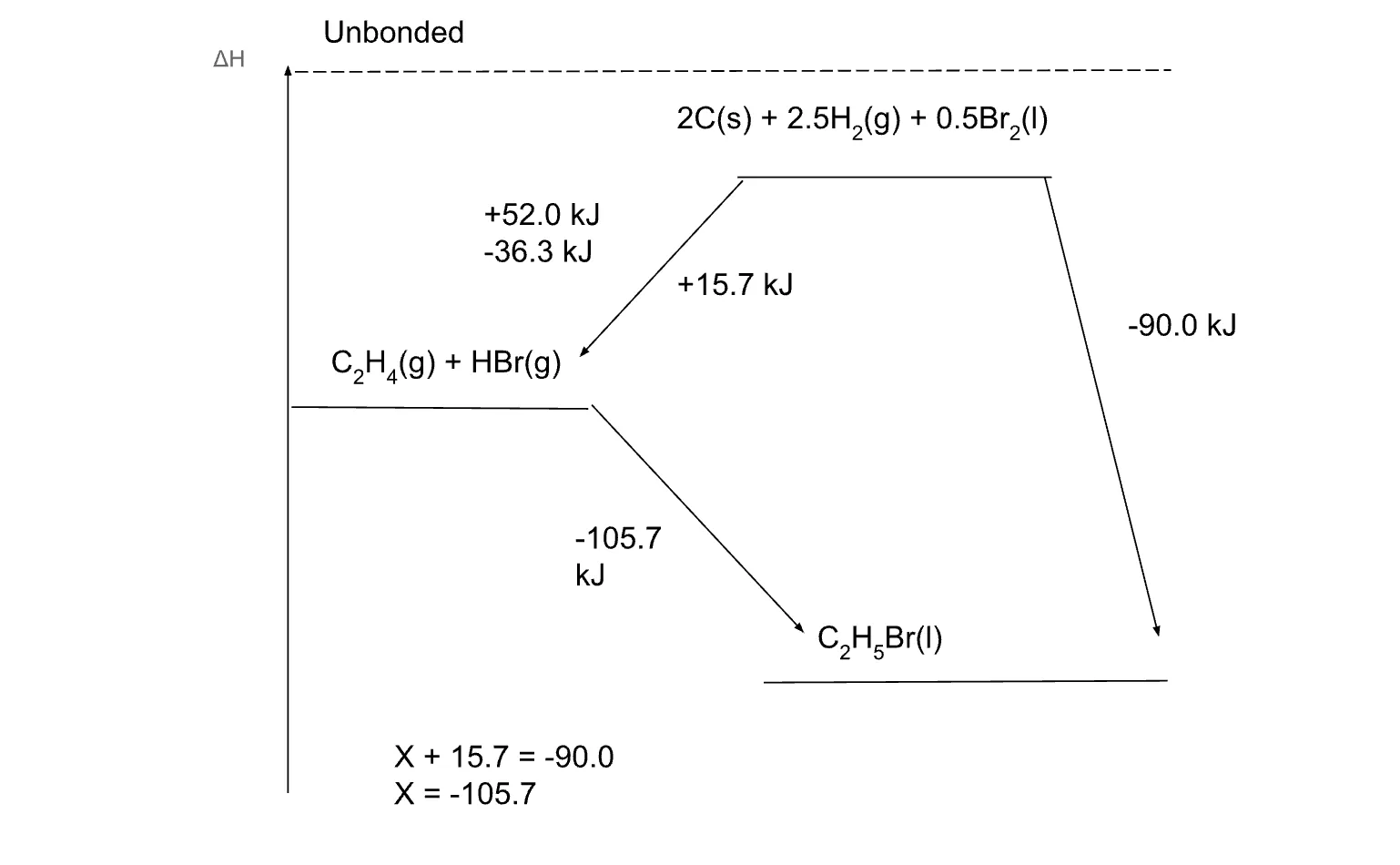
Hess’s Law: Hess’s Law states that the energy required to transform the reactants into ESS and then into products is equal to the energy required to turn the reactants into the products.
ΔHf, go both ways, meaning that it requires the same amount of energy to separate them into their ESS as their enthalpy of formation.
Provided:
- An equation
- ΔH of formation for each compound
- Elements in standard states (ESS)
Solving Hess’s Law Problems:
Determine the enthalpy of reaction of:
| kJ/mol | |
|---|---|
| +52.0 | |
| -36.3 | |
| -90.0 |
We can draw a quick diagram: