Mass Spectrometry
- Describe the operation of mass spectrometer. Identify elements and perform calculations involving a mass spectrum and average atomic mass.
Spectrometer (How It Works)
- Atoms are ionized
- Ionized atoms are shot through a narrow tube, with each atom having the same KE
- Since the KE is the same, while the different isotopes are different, different isotopes travel at different veolcities, allowing them to be separated.
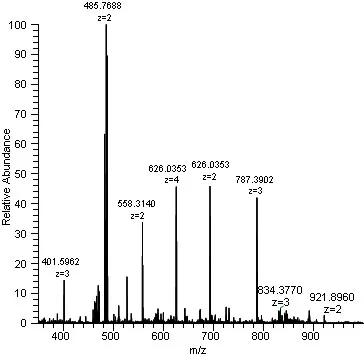
Reading/Analyzing Specetrometer Readings
-
Estimating Average AMU:
- For each mass point, multiply it by the relative abundance (i.e. if some 90 M/Z has an abundance of 50%, multiply 90*50%).
- Add all the values together and divide by the sum of the relative abundances, to get the average AMU.
-
Identifying Elements:
- Find the average AMU
- The element with the closest AMU to the AMU you just found is probably the element
-
M/Z:
- Mass to Change ratio
- Occurs on the x-axis because relative abundance depends on M/Z, and it seperates isotopes by mass.
AMU to % Composition
Ex: It is found that a sample of uranium from a power plant in Germany has average atomic mass of 236.8 AMU. Find percentage composition of U235 and U238.
Note that % comp of both elements must add up to 1 (or 100%). Thus, assign one of the elements, suppose U235, to be x. Then, U238 is 1-x.
Since U235 and U238 have masses of 235 and 238 AMU, respectively, the average atomic mass is the weighted average of the two isotopes. Thus, the equation is:
Solving, we get that x = 0.4, and thus U235 is 40% and U238 is 60%.