Rutherford Model
- Describe and explain the evidence that led to Rutherford’s nuclear model of the atom, as well as the discovery of protons and neutrons.
Rutherford’s Gold Foil Experiment
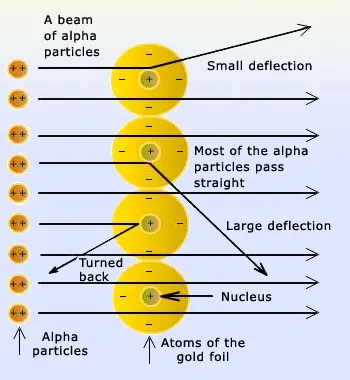
- Alpha particles are emitted from poponium at gold foil, that is only a few atoms thick.
- The foil is coated with zinc sulfide, which emits a flash of light when struck by an alpha particle.
- Most alpha particles pass through the foil, but some are deflected at large angles.
Experimental Results & Model
- Rutherford thought an atom was mostly empty space and it contained a small & dense nucleus.
- Positively charged nucleus contained most of the mass, while electrons orbitted.
- Particles that got too close to the nucleus were deflected.
Several questions also arose from this experiment:
What holds the nucleus together?
Chemists invent some arbitrary force noboyd can explain called strong nuclear force holds the nucleus together.
Why don't electrons fall into the nucleus?
See Unit 10 :)
Rutherford Gold Foil Diagram
Mosley’s Law
Mosley shoots a bunch of elements with cathode rays, causing an emission of X-rays. He found that graphing the square root of X-ray frequency to some very specific integer N would make a linear relationship on the graph.
- This integer N is the atomic number of the element.
- This law helped to reorganize the periodic table by atomic number, not atomic mass.
- Elements in solid samples were able to be identified by their X-ray frequencies.
- Helped discover elements 43, 61, 72, 75, 85, and 87.