Dipole Forces and Electronegativity
- Explain how electronegativity is defined and make predictions about polarity, BDEs, and periodic trends in electronegativity.
Dipole Forces
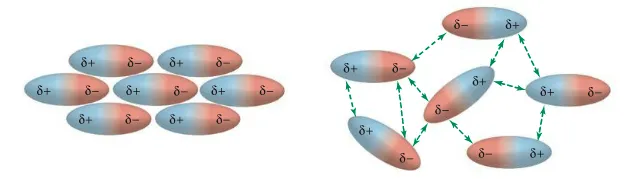
- Dipole-dipole forces exist between molecules that are polar: those that have a permanent dipole moment due to uneven sharing of electrons.
- Uneven sharing gives one side of the molecule a partial positive charge (δ+) and the other side a partially negative charge (δ-)
- In general, dipole-dipole is stronger than LDF, and therefore, would have higher boiling or melting points than particles binded with LDF.
Electronegativity
Electronegativity: Electronegativity is a measure of the tendency of an atom to attract a bonding pair of electrons.
Down a period, electronegativity usually increases, while down a group, it decreases. These trends depend on: The attraction that a bonding pair of electrons feels for a particular nucleus depends on:
- the number of protons in the nucleus;
- the distance from the nucleus;
- the amount of screening by inner electrons.
More generally, just use a periodic table that contains each of the electronegativities of the elements to figure out the electronegativity of an element.
Dipole Moment
We can compute the dipole moment by comparing all the electronegativities of the atoms with the core atom, and seeing about what direction of the resulting vector is. A larger dipole moment generally means the molecule is more polarized, and has larger BP or MP.